
The New HHSRS: What Changed in June 2026 and What Landlords Need to Know
The HHSRS is the system councils use to assess whether rental properties are safe and fit to live in. It identifies hazards that could affect tenant health and safety and determines what action councils can take if problems are found. This system applies to all private rental properties in England.
The Key Changes to HHSRS
The old system was notably complex, assessing 29 separate hazards and utilising a lettered scoring system (A through J) that few truly understood. The new system simplifies this considerably:
- Fewer Hazards: The system now covers 21 hazards instead of 29. Some similar issues have been combined, but it's important to note that the underlying safety standards haven't changed.
- Clearer Categories: Instead of letters A to J, there are now just three bands: High, Medium, and Low. This makes the severity of a problem immediately obvious.
- Faster Enforcement: This is perhaps the most significant change. Councils can now issue financial penalties immediately for serious (High/Category 1) hazards, without going through warning periods or giving time to remedy the issue first. This is a new and impactful development.
How Hazards are Categorised
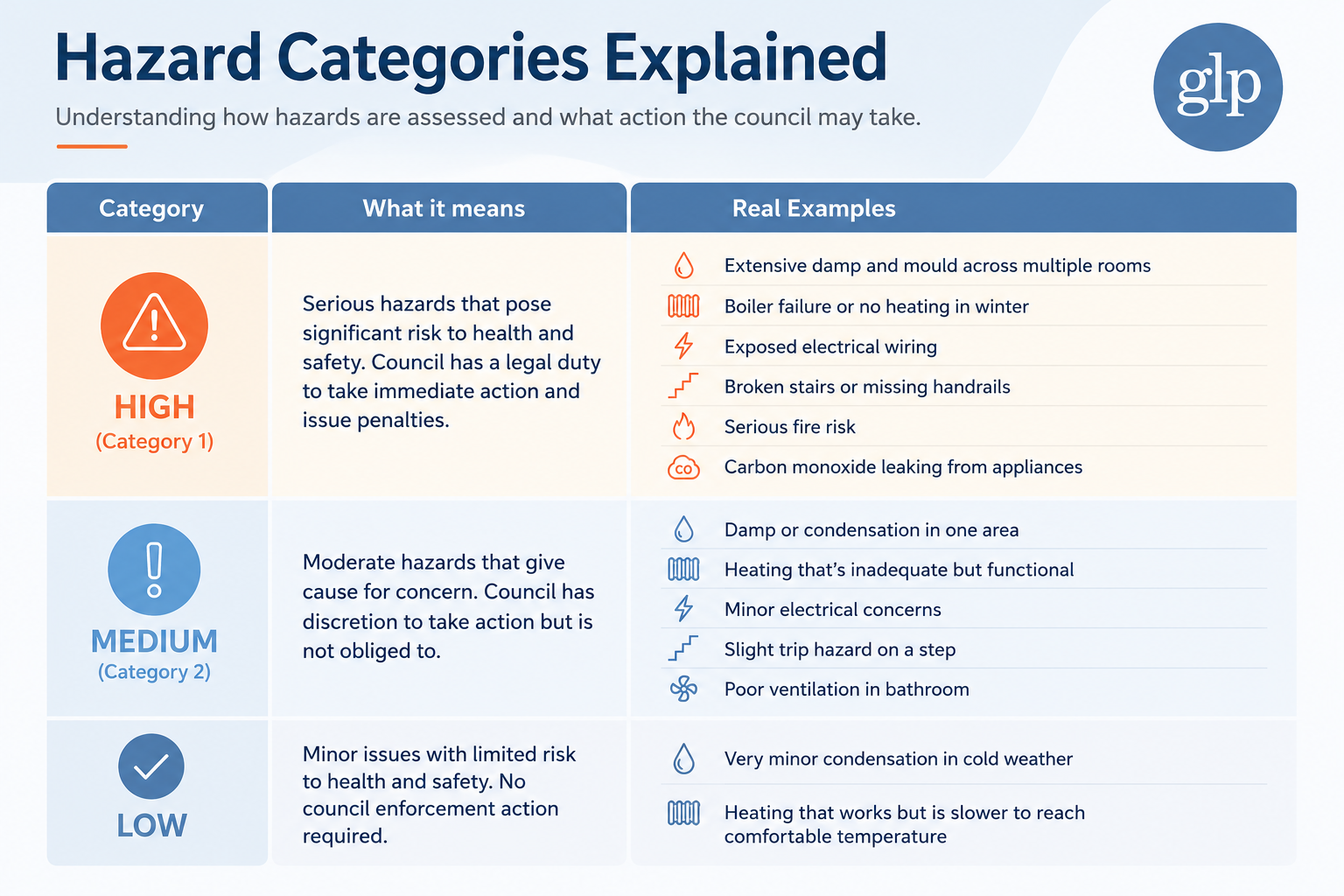
The HHSRS categories reflect severity and risk. The same type of hazard can fall into different categories depending on how serious the problem is. For example, a minor patch of damp might be 'Low', while widespread, penetrating damp causing mould across multiple rooms would be 'High'.
Which Hazards Are Most Common?
Data consistently shows that three types of hazard account for a significant 88 per cent of all Category 1 (serious) hazards found in private rentals:
- Falls on stairs, level surfaces and between levels: This accounts for 54% of all serious hazards. Examples include broken balusters, uneven step heights, missing handrails, and unstable flooring.
- Excess cold: This makes up 24% of all serious hazards. Typically, this refers to inadequate heating systems or poor insulation that leaves properties at dangerously low temperatures, particularly during winter months.
- Damp and mould: This covers 4% of all serious hazards. This includes extensive or widespread dampness and mould growth caused by structural problems, water ingress, or poor ventilation.
What Changed About Enforcement?
Previously, when a council found a serious hazard, they would follow a staged approach. They would issue a notice, give the landlord time to remedy the problem, and potentially take further action if the landlord didn't comply. It was a process that allowed for a period of rectification.
Under the new system, this changes dramatically. If a council inspection identifies a HIGH (Category 1) hazard, financial penalties can be issued immediately, without prior notice or a chance to remedy. This means that issues like a broken boiler in winter or widespread damp across multiple rooms can trigger a penalty straight away.
Additionally, each separate hazard can now be fined individually. So, a property with multiple distinct issues, such as a heating problem, electrical defects, and significant damp, could face multiple penalties at once, significantly increasing the financial implications for landlords.
What This Means in Practice for Landlords
For landlords, the underlying message remains consistent with previous versions of HHSRS: properties need to be maintained to a safe and habitable standard. However, the pace and severity of enforcement have accelerated significantly.
Properties that are well-maintained, with functioning heating, safe stairs, no structural damp, and safe electrical systems, will have nothing to worry about. Council inspections, whether triggered by a tenant complaint or a proactive visit, should find nothing of concern.
Conversely, properties where maintenance has been chronically neglected, or where reported issues have been ignored, are now at serious risk. A council visit will no longer result in a warning letter and time to fix; it will result in immediate penalties. The HHSRS is not a new standard; it's a simplification of an existing one. But the enforcement now has significant teeth in a way it didn't before. That's the real change that landlords must be aware of and prepared for.
What GLP will be doing for our managed landlords
If GLP manage your property your properties will receive mid-term property inspections, where we will do this following:
- Clear record-keeping: Every inspection is documented. We record what we find, what condition things are in, and what actions we take. If a hazard is identified, we log it and create a remediation plan. This record becomes invaluable if a council inspection ever occurs. Instead of being caught off guard, we can show that we identified the issue and acted on it.
- Swift remediation: When we identify a hazard—whether it's a heating problem, structural damp, or unsafe stairs—we don't wait. We arrange for repairs or remedial works immediately. The goal is to address problems before they become enforcement issues. This protects you from penalties and, more importantly, ensures your tenants are living in safe, properly maintained properties.
- Proactive communication: If we identify any issue during inspection, we notify you immediately with a clear explanation of what was found, what the risk level is, and what we recommend. You're kept informed every step of the way.
📸 @greaterlondonproperties | @glpdulwich