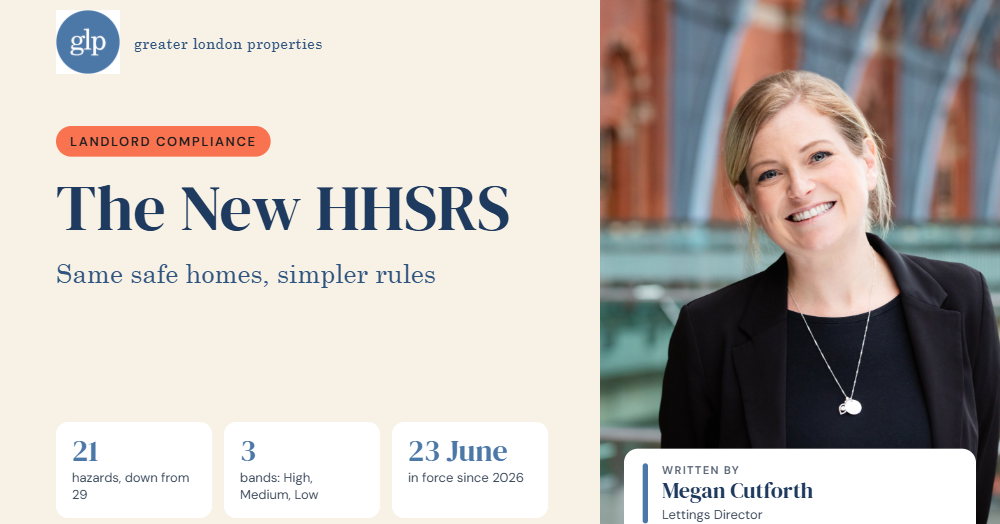
The New HHSRS: Same Safe Homes, Simpler Rules
The way councils rate hazards in rented homes has had its first real refresh in nearly 20 years. Fewer categories, simpler scores and a new £7,000 penalty. Here is what it means for your property, a handy check list and advice on how to keep well ahead of the rules.
Since 23 June 2026, councils in England have been assessing rented homes under an updated Housing Health and Safety Rating System (HHSRS), its first proper overhaul since 2006. It is the tool environmental health officers use to judge whether a home poses a risk to health or safety, scoring each hazard on how likely it is to cause harm and how serious that harm could be.
The good news is that the heart of it has not changed. Keep your home safe and well looked after, and you are already doing what the rules ask. What has changed is how hazards are scored, how reports read and how quickly a council can act. Here is our round up.
What has actually changed
21 hazards instead of 29
Hazards that behave in similar ways have been merged:
- Falls on the Level now brings together trips on flat floors, small changes in level and slips around baths and showers.
- Indoor Air Pollutants gathers up carbon monoxide, nitrogen dioxide and volatile organic compounds.
- Domestic Hygiene now covers food storage, sanitation, pests and waste.
Fewer headings does not mean fewer risks, just a tidier way of grouping them.
A wider view of fire
The fire hazard now covers harm from uncontrolled fire and its smoke or fumes, explosions, and any building collapse caused by either. There is a whole supplementary part of the operating guidance devoted to it. For older buildings and conversions, which describes a good share of homes across Soho, Bloomsbury and Marylebone, this is a sensible one to look at closely.
Harm described in plain English
The four classes of harm, previously numbered I to IV, are now called Extreme, Severe, Serious and Moderate. Nothing about what they cover has changed, but your inspection reports may read differently from now on.
The part worth paying attention to: penalties
Councils can now issue a civil penalty of up to £7,000 the first time they act on a Category 1 hazard that could reasonably have been fixed. As the NRLA notes, it can apply to each hazard separately, without a warning first, and on top of an improvement notice.
Alongside this, ignoring an improvement notice can now cost up to £40,000, rent repayment orders can reach two years' rent, and appeal windows are usually just 21 days.
None of this is designed to catch out responsible landlords, which is why good habits and good records make all the difference.
Good records are your quiet safeguard
Whether a penalty is appropriate depends partly on whether it was reasonably practicable for you to deal with the hazard. A clear paper trail answers that question for you.
Inventories, periodic inspection reports, check out reports, repair invoices, dated photos and copies of your safety certificates all build a picture of a landlord who notices problems and acts on them. It does not need to show perfection, just awareness, reasonable action and a prompt response when tenants report something.
What is coming next
The new HHSRS also sets the scene for a few changes on the horizon.
- Awaab's Law has applied to social housing since 27 October 2025, setting fixed timescales for fixing damp, mould and emergency hazards. The government has now opened consultation for this which will close on the 18th December 2026 on how it should apply to private rented homes, and it uses the new list of 21 hazards as its reference point.
- A Private Rented Sector Landlord Ombudsman is being set up, giving tenants a route to complain if they feel a reported problem has not been handled well.
Landlords who get comfortable with the HHSRS now will find each of these steps a gentle one rather than a leap.
Your simple HHSRS checklist
The government guidance now includes baseline indicators, a practical checklist of reasonable standards covering everything from drainage and heating to damp, pests and fire safety. They are not compulsory, but anything falling short is generally treated as a deficiency. We have folded the key ones into our checklist below.
With the clocks about to go back, autumn is the ideal moment for a quick health check.
- Use the official checklist. Walk through your property with the baseline indicators checklist from Appendix A of the government's landlord and agent guide.
- Stairs. Carpets firmly fixed, handrails on any flight with four or more risers, and good lighting throughout.
- Windows. Restrictors limiting openings to under 100mm wherever someone could fall a storey or more.
- Heating. A system that can bring the living room to 21°C and other rooms to 18°C when it is minus 1°C outside, with decent insulation to match.
- Damp and ventilation. Extractor fans vented outside and in working order, no visible mould across more than 5% of any wall or ceiling, and quick action at the first sign of condensation.
- Hot water. No hotter than 45°C at the tap.
- Certificates. An annual gas safety check, an electrical inspection at least every five years, a smoke alarm on every storey, carbon monoxide alarms wherever there is a fixed combustion appliance, and an EPC rated E or above.
- Records. A dated log of inspections, repairs, photos and conversations with your tenants.
- Response. Deal with repair requests promptly, and if a council notice ever arrives, act on it straight away.
How we can help
At Greater London Properties we have been looking after homes across Central London since 2003, and keeping them safe is simply part of how we work.
Our Property Management team carries out regular inspections, keeps track of every certificate and renewal, arranges trusted contractors and keeps a clear record of everything along the way.
The good news is that a safe, well kept home is also a home that lets quickly, attracts great tenants and holds its value. The new HHSRS simply puts a clearer framework around what good landlords already do.
If you would like a friendly chat about your property, or a fresh pair of eyes on it before winter, we would love to hear from you.
Kind Regards
Megan Cutforth
Greater London Properties Your Home, Your Story
Our Values ✨ Accountable • Ambitious • Approachable • Authentic
☎️ 0207 113 1066 | ✉️ info@glp.co.uk 📸 @greaterlondonproperties | @glpdulwich